
When Ransomware Strikes, Preparation Matters
No business expects to become the target of a ransomware attack.
Most organizations believe it won't happen to them—until an employee clicks a malicious email, a stolen password gives an attacker access to the network, or an unpatched vulnerability becomes the opening cybercriminals were looking for.
In our previous blog, When Minutes Matter, we explored what happens after a cyberattack begins and how West Central Technology's Cyber Response Team helps organizations respond when every minute counts. While rapid response is critical, the reality is that the best ransomware recovery is the one you never have to experience.
No security solution can guarantee that your organization will never be attacked. Cybercriminals are constantly evolving their tactics, and even well-protected organizations can become targets. The difference is that businesses with a proactive cybersecurity strategy are far more likely to prevent attacks—or stop them before they cause widespread damage.
So, what does that strategy look like?
Your Employees Are Your First Line of Defense
Technology plays an important role in cybersecurity, but people remain one of the biggest targets for attackers.
Most ransomware attacks don't begin with sophisticated hacking techniques. Instead, they start with a convincing phishing email, a fake login page, or a phone call designed to trick someone into sharing sensitive information. It only takes one click for an attacker to gain a foothold inside your network.
That's why cybersecurity awareness training should be an ongoing part of your organization's culture—not a one-time event during employee onboarding.
Regular training helps employees recognize phishing attempts, understand how attackers manipulate people through social engineering, and know what to do when something doesn't seem right. Simulated phishing campaigns are also valuable because they provide real-world experience while helping identify areas where additional education may be needed.
When employees understand that cybersecurity is everyone's responsibility, they become an active part of your organization's defense instead of its greatest vulnerability.
Strong Security Requires Multiple Layers
There's no single product that stops ransomware. Effective cybersecurity comes from building multiple layers of protection that work together.
One of the simplest and most effective steps businesses can take is enabling Multi-Factor Authentication (MFA). Even if an attacker steals a password, MFA requires a second form of verification before access is granted, dramatically reducing the likelihood of a compromised account.
Endpoint Detection and Response (EDR) provides another critical layer of protection. Unlike traditional antivirus software, EDR continuously monitors computers and servers for suspicious behavior. It can identify unusual activity—such as unauthorized encryption, privilege escalation, or lateral movement across the network—and help stop attacks before they spread.
Email security also remains essential. Since phishing emails continue to be one of the most common delivery methods for ransomware, advanced spam filtering helps reduce the number of malicious messages that ever reach an employee's inbox.
None of these technologies are meant to work alone. Together, they create multiple obstacles that make it significantly harder for attackers to succeed.
Your Backups Are Only Valuable If They Can Be Recovered
Nearly every business says they have backups.
The more important detail is whether those backups will still be available during a ransomware attack.
Today's attackers often attempt to locate and destroy backup systems before deploying ransomware. If backups can be deleted or encrypted, organizations may have far fewer recovery options.
That's why we recommend following the 3-2-1 backup strategy: maintain at least three copies of your data, store them on two different types of media, and keep one copy offsite or immutable so it cannot be altered by attackers.
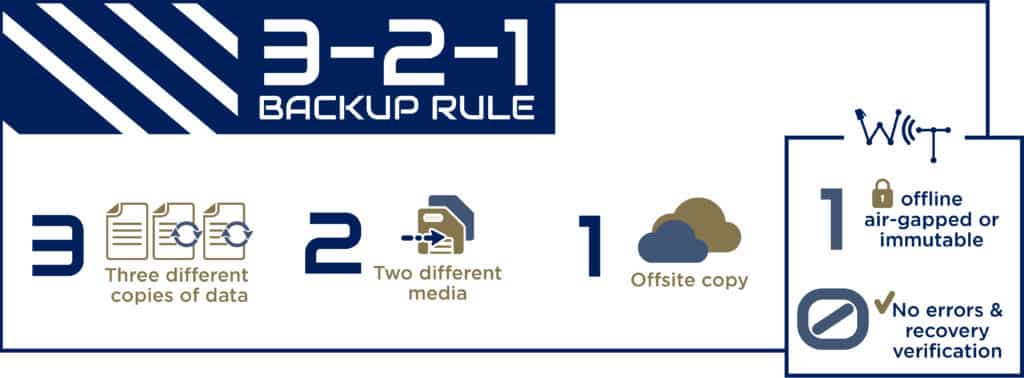
Equally important is testing your backups on a regular basis. A backup that hasn't been verified may not work when you need it most. Regular recovery testing provides confidence that your data can actually be restored and your business can return to normal operations as quickly as possible.
Proactive Maintenance Closes the Door on Attackers
Many successful cyberattacks exploit vulnerabilities that organizations already knew about but haven’t yet addressed.
Keeping operating systems, applications, firewalls, and other business-critical software updated helps close these security gaps before attackers can take advantage of them. Routine patch management may not receive much attention, but it's one of the most effective ways to reduce cyber risk.
Organizations should also regularly review user permissions and follow the Principle of Least Privilege, ensuring employees only have access to the systems and information necessary for their jobs. Limiting unnecessary access helps reduce the potential impact if an account is compromised.
Cybersecurity isn't just about responding to threats. It's about continuously reducing opportunities for attackers to gain access in the first place.
Have a Plan Before You Need One
One of the biggest differences between organizations that recover quickly and those that struggle is preparation.
When a ransomware attack occurs, emotions run high and decisions often need to be made quickly. Trying to determine who should be contacted, what systems should be disconnected, or how to communicate with employees during an emergency wastes valuable time.
A documented Incident Response Plan provides clear direction before an incident ever occurs. It identifies key decision-makers, outlines communication procedures, includes important contacts such as cyber insurance providers and legal counsel, and establishes the steps necessary to contain and recover from an attack.
Just as importantly, the plan should be reviewed and practiced regularly. An incident response plan that's never been tested is unlikely to perform well during a real emergency.
Cybersecurity Is an Ongoing Partnership
Cybersecurity isn't a project you complete once and forget about. It's an ongoing process of evaluating risks, adapting to new threats, and continuously improving your defenses.
At West Central Technology, we work with organizations to build proactive cybersecurity strategies that go far beyond responding to emergencies. We help businesses strengthen their resilience before attackers have an opportunity to strike through security assessments, employee awareness training, endpoint protection, backup planning, vulnerability management, and incident response planning.
Our goal isn't simply to help clients recover from cyber incidents—it's to help them reduce the likelihood that they'll experience one in the first place.
Prevention Starts Today
Ransomware continues to evolve, but so do the tools and strategies available to defend against it. Businesses that prioritize employee education, implement layered security, maintain secure backups, and prepare for the unexpected are in a much stronger position than those that rely on luck alone.
The question isn't whether cybersecurity should be a priority. It's whether your organization is prepared before an attacker comes knocking.
If you're unsure where your business stands, West Central Technology can help. Our team will evaluate your current cybersecurity posture, identify areas for improvement, and build a strategy designed to keep your organization secure, resilient, and ready for whatever comes next.
Contact West Central Technology today to schedule a cybersecurity assessment and take the next step toward protecting your business from ransomware.